What is the modern handgun? Why is this piece of crafted metal and (recently) hard plastics still in great demand not only in military forces and police departments ALL around the world? The answers are: They are small, lightweight (well, most of them :-) and provide good firepower; suitable, not only for defensive situations, but for offensive ones, and even for medium game hunting. Of course, for each situation, careful choice of the proper handgun AND ammunition must be made. Handguns are divided into a few classes: semi-autos (or pistols), revolvers, and non-autos (single or multibarreled, single-shot or magazine fed). Semi-autos use part of the energy produced by burning cartridge powder to remove the used cartridge from the chamber, cock the hammer (or striker) and load a new cartridge in the chamber, so the pistol will be ready for the next shot. Cartridges are usually fed from a box magazine, located in the pistol's handle. Box magazines may contain up to 15 cartridges (or more) in single or double columns, depending on the pistol model, and are easy (and very quick) to reload.
All handguns are divided into one of two major groups depending upon the location of the chamber. Revolvers have a revolving chamber; pistols have a chamber integral with the barrel. There are various sub-types.
Some handguns are:
single-shot pistols,
revolvers,
semi-automatic pistols, and fully automatic pistols. In the
15th century the term "pistol" was used for small knives and daggers which could be concealed in a person's clothing. By the
18th century the term came to be used exclusively to refer to hand-held firearms.
Both revolvers and semi-autos have two main "action styles": Single action and Double action. Single Action means, that the Revolver must be manually cocked (and, thus, the cylinder is rotated to the next cartridge) for each shot. This mode was the only one available in all old-time revolvers (such as the Peacekeeper), and is still available in most double-action revolvers. This mode improves accuracy but slows the fire rate. For Semi-autos, Single Action means that the pistol must be manually cocked for the first shot (usually, this is done by pulling the slide - this action cocks the hammer and feeds a cartridge into the chamber). For the second, and all consecutive shots, cocking is done automatically, when recoil force pulls back the slide. Double Action for the Revolver means that the hammer for each (including the f irst) shot is cocked by trigger pull (this action also rotates the cylinder to the next position). This mode speeds up the firing rate and simplifies shooting actions, but greatly increases trigger pull (from 2.2-4.4 lbs usually found in single-actions, to 8.8-12.2 lbs in double-actions). For the Semi-autos, the hammer is usually cocked by trigger pull for the first shot only; the second and the rest are done in single-action mode. However, first load must be fed in the chamber by the slide pull. Some (most of them - compact) semi-autos and revolvers employ Double-action-only mode, which cocks the trigger for each shot, thus excluding single-action. One of the biggest questions about handguns is: Why the Six-guns (a slang TERM for Revolvers) are stil alive when there's a big lot of the very reliable and larger capacity semi-auto handguns? The oldest answer is - reliability. Usually, given the same price (in low- or mid-range of prices), the revolvers were more reliable, primarily, because of the simplicity of the design. Today there's a lot of inexpensive semi-autos, that can hold twice or even triple as much loads ready to fire, than the common sixguns. But revolvers still alive. One of the main reasons to keep the revolver is that they're almost insencetive to ammunition. If your cartridge is capable of pushing a bullet thru the barrel of the sixgun - you got the working gun. No jams, no stoppages. Even in the case of the misfire you just got to pull the trigger again - and next round will go. In semi-auto, you need sufficient power to cycle the slide, thus rendering underpowered loads almost inoperable in semi-autos. Also, in case of the misfire, or jam, you should manually cycle the slide to fire the next round. In defensive scenario, this may cos you another second, and may be - your life. So, in general, sixguns are far less sensetive to ammo quality, and, due to simplicity and inherent design features, could withstand far more abuse. Also, when you go to the other, high-end of the loads (speaking in the terms of power), no semi-autos could withstand the power of loads such as .454casull or .475Linebaugh. Sixguns could.Main drawbacks of the sixguns are small ammo capacity, slower reloading and bulkier size. While 6 rounds may be sufficient for self-defence scenarios, it may be really insufficient for the police or SpecOps actions. Also, replacing the magazine in semi-auto ususlly is much faster process than reloading a revolvers' drum. And, due to significant cylinder diameter, even the 5-shot revolvers are harder to carry concealed, than the modern compact handguns, while the latter could hold tvice as much cartridges. Final selection of the guns is, undoubtfully, the owners' responcebility, but, in my opinion, revolvers are more suitable for civilians' self-defence and for hunting, while semi-autos are better combat and police guns.
The term "pistol" may be derived from the
French pistole (or pistolet), which, in turn, comes from the
Czech píšťala (flute or pipe, referring to the shape of a
Hussite firearm). Other suggestions have been made—that it comes from city of
Pistoia,
Italy, where perhaps a manufacturer was one Camillio Vettelli in the 1540s; or that early pistols were carried by cavalry in holsters hung from the
pommel (or pistallo in
medieval French) of a horse's saddle.
Types of handgun
Varieties of handgun: "
automatic" self-loading pistols,
revolvers including black powder revolvers, multi-barreled pistols, single-shot hunting or target pistols and finally flintlock pistols. In a pistol, the
chamber, in which the cartridge is held for firing, is the rearmost portion of the
barrel. Thus the term "pistol" technically excludes revolvers, although this distinction is often ignored in colloquial usage, where revolvers are commonly referred to as "pistols."
Flintlock
The flintlock firing mechanism dates back to the 16th century, although it was another hundred years before it was generally used in infantry muskets, by which time it had been perfected. It survived well into the 19th century and was often known as the French lock because Marin le Bourgeoys, a French gunmaker working in Paris for Henry IV's Louvre, had invented it - in about 1610. He had modified a much more complicated mechanism into a simpler one-piece mechanism. It was also called a firelock. The basic action is that the trigger is pulled and a spring causes the striker, the frizzen, to strike the flint which showers sparks on to the gunpowder in the priming pan.
Multi-barreled
Multi-Barreled pistols such as some variants of
Derringer and Pepper-box pistols are still in circulation today. The Pepper-box pistol is a multishot handheld
firearm, which was popular in
North America around the time of the American Civil War. The pepperbox was invented in the 1830s and was meant mainly for civilian use. It spread rapidly in the
United Kingdom and some parts of continental Europe. It started disappearing gradually in the 1850s with the manufacture of true revolvers by Colt, Webley and others. It was similar to the
revolver since like it, it held bullets in a rotating cylinder, in separate chambers. Unlike the revolver however, each bullet had its own barrel.
Revolvers
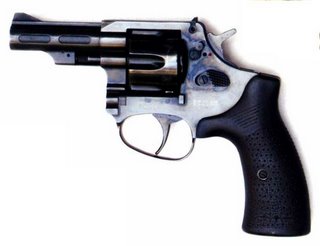
Image: China Police Revolver
Revolvers got their name from the rotating (or Revolving) cylinder, which contains cartridges. Usually the cylinder holds from 5 to 7 loads, although some .22 caliber revolvers may contain up to 8-10 cartridges. Loads in the cylinder may be reloaded in 2 ways (depending on revolver design) - one by one, as, for example, the Colt PeaceKeeper does (and almost all old-timers), or all simulateounosly - when the cylinder is switched to the side or when the is frame "broke open."
Revolvers feed
ammunition via the rotation of a cartridge-filled
cylinder, in which each cartridge is contained in its own ignition chamber, and is sequentially brought into alignment with the weapon's barrel by a mechanism linked to the weapon's trigger (double-action) or its hammer (single-action). These nominally cylindrical chambers, usually numbering between five and nine depending on the size of the revolver and the size the cartridge being fired, are bored through the cylinder so that their axes are parallel to the cylinder's axis of rotation; thus, as the
cylinder rotates, the chambers revolve about the cylinder's axis. Due to simplicity of construction and operation, revolvers are considered to be more reliable than semi-automatic pistols.
Automatic pistols 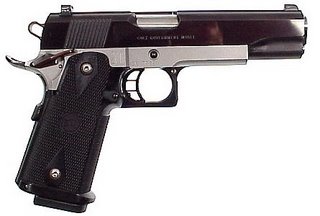
Image: Colt 1911
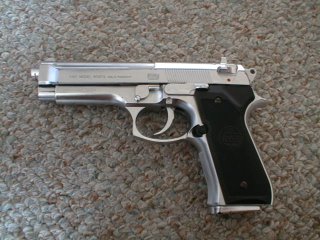
Image: Berreta 92
Automatic pistols continue to fire so long as the trigger is held back. The term automatic pistol is commonly used to refer to an automatic or semi-automatic pistol.
Operating Mechanisms
Single-action (SA) handguns have a trigger mechanism whose sole function is to drop a pre-cocked hammer to discharge a cartridge. For revolvers the popular
Colt Peacemaker of
Old West fame is typically thought of. Its hammer must be manually cocked for each shot. For auto-loading pistols the
Colt 1911 or
Browning Hi-Power are typical examples. They must be cocked for the first shot, but subsequent shots are cocked automatically. These types of guns typically have a very light and crisp trigger pull, making for more accurate target shooting.
Traditional double-action (TDA) handguns have a mechanism that can be either pre-cocked, like the above single-action gun, or can be fired with the gun uncocked. In this case, the gun has an additional mechanism added to the trigger that will cock the gun (and rotate the cylinder in the case of revolvers) as the trigger is pulled. Once the trigger is pulled far enough, the hammer is released and the gun fired. For autoloading pistols the self-loading mechanism will also re-cock the hammer after the first shot is fired so that subsequent shots are fired single-action. For revolvers, each shot is fired with the hammer initially uncocked unless the shooter manually cocked the gun. Popular auto pistols in this category include the
Walther P38 and
Beretta Model 92. These guns typically have a longer, heavier trigger pull for the first shot then light, crisp pulls for subsequent shots. Popular revolvers include the
Ruger Redhawk and
Smith & Wesson Model 629. These have long, heavy trigger pulls for all shots unless the revolver is manually cocked.
Double-action only (DAO) handguns do not have the ability to be cocked and is usually evidenced by a lack of either the hammer spur or the entire hammer A typical autopistol in this category is the
Ruger KP93DAO and
Taurus Millennium, and a typical revolver is the
Smith & Wesson Model 640 "Chief's Special". All pistols in this category have a long, heavy trigger pull for all shots.
Pre-set triggers are only on autoloading pistols. In this case the pistol mechanism is always partially cocked while being carried and during firing. The partially-cocked firing pin or striker is not cocked enough to cause an accidental release to discharge a cartridge, adding to the safeness of the design, but is cocked enough to remove much of the trigger pull and weight of a purely double-action pistol. These types of pistols do not have external hammers and do not generally have a decock function. Common pistols in the category are the
Springfield Armory XD and the various forms of the extremely popular
Glock. The trigger pull of these guns is between double-action and single-action pistols. Pre-set triggers may or may not have a second-strike feature on a dud cartridge.
Some automatic pistol models such as the HK
Heckler & Koch USP (Universal Self-loading Pistol) come in a variety of mechanism types and can be easily changed by a
gunsmith for both left- and right-handed shooters and for different operating mechanism and safety features.
Machine pistols
A
machine pistol is generally defined as a firearm designed to be fired with one hand, and capable of fully automatic or
selective fire. While there are a number of machine pistols such as the
GLOCK 18 and later models of the Mauser
C96, these are rare; the light weight, small size, and extremely rapid rates of fire of a machine pistol make them difficult to control, making the larger, heavier
submachine gun a better choice in cases where the small size of a machine pistol is required. Most machine pistols have the ability to attach a shoulder stock (the Heckler & Koch VP70 would only fire single rounds unless the stock was attached) while others, such as the
Beretta 93R, add a forward handgrip. Either of these additions technically create a legal non-pistol under the US
National Firearms Act, as pistols are by definition designed to be fired with one hand. The addition of a stock or forward handgrip is considered a design change that creates either a short-barreled rifle or any other weapon, and therefore such additions are generally only found on legal machine guns.
Advantages of pistols
Pistols are smaller, lighter, easier to conceal, faster to bring to bear, and sometimes may have more safety features than other firearms.
Generally being an emergency self-defense weapon for use under 25 meters, a handgun bullet neither has the energy of, nor the accuracy of, a bullet shot from a
rifle.

 11:29 PM
 Te Effendi



 Image: China Police Revolver
 Image: Berreta 92
  Posted in: Balistik

